
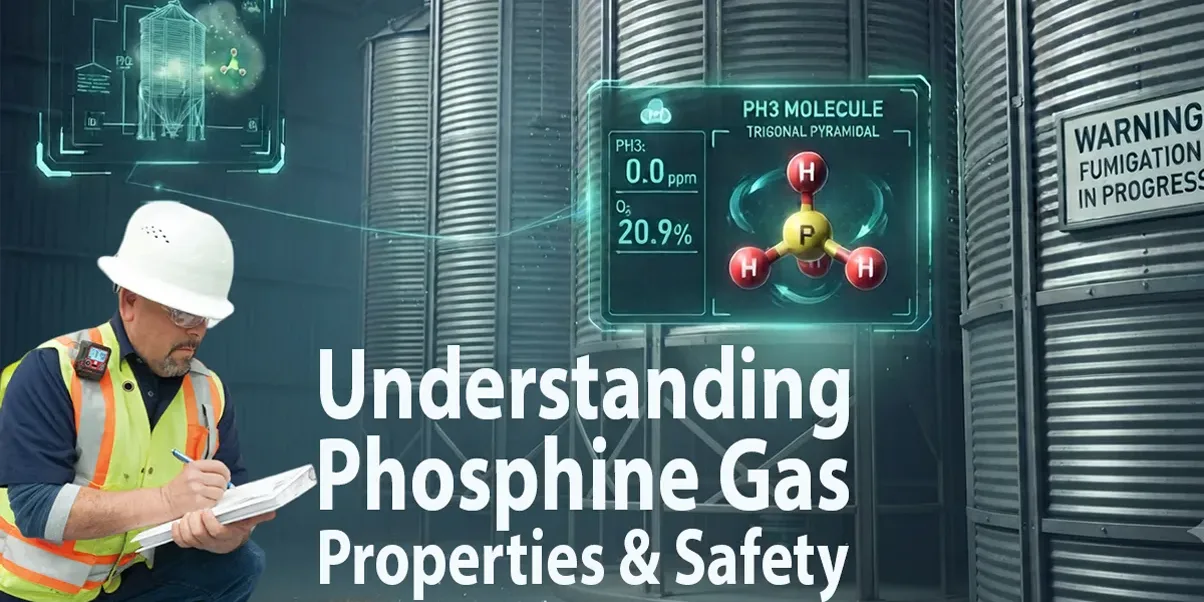
What is Phosphine Gas?
The Hidden Risk in Grain Stores, Fumigation Sites, and Industrial Plants
Phosphine gas (PH3) has a reputation problem: most people think of it only when something has already gone wrong. It’s colourless, often odourless in its purest form, heavier than air, and capable of self-ignition — which means that by the time you can smell it, you may already be standing in a dangerous concentration.
For grain handlers, fumigators, pest control operators, and anyone working near aluminium phosphide, understanding phosphine isn’t optional. It’s the difference between a routine day and a medical emergency.
Where Phosphine Gas Comes From
Phosphine is commonly generated during fumigation when aluminium phosphide tablets react with moisture in the air. It’s also present in trace amounts in nature, produced by the decomposition of organic matter, and appears as a by-product in some industrial processes, such as welding and metal alloy production.
Because of how effective it is at killing pests without leaving chemical residue on grain, phosphine is widely used across:
-
- Grain storage and fumigation
- Rodenticide and pest control
- Semiconductor and microchip manufacturing
That widespread use is exactly why exposure risk is so common — and why gas detection has become a non-negotiable part of doing this work safely.
Why You Can’t Rely on Your Nose
Phosphine in its pure form is odourless. When contaminated, it can produce a faint garlic or rotting-fish odour — but that smell is unreliable, and relying on it is genuinely dangerous. Concentrations can build to hazardous levels in enclosed or poorly ventilated spaces well before anyone notices anything unusual.
This is the single most important thing to understand about phosphine: your senses will not reliably warn you. Only calibrated gas detection equipment can.
Health Risks of Phosphine Gas Exposure
When inhaled, phosphine gas disrupts the body’s ability to absorb and use oxygen. Short-term exposure can cause:
| Short-term exposure can cause: | High exposure can cause: | Chronic low-level exposure has been linked to: |
|
|
|
Workplace Exposure Standards
Australia’s workplace exposure standards are tight for a reason – current Australian workplace exposure standards (WES) for phosphine gas are:
| Limit | Value |
| 8-hour Time-Weighted Average (TWA) | 0.3 ppm (0.42 mg/m³) |
| 15-minute Short-Term Exposure Limit (STEL) | 1 ppm (1.4 mg/m³) |
Staying inside these limits requires ongoing, reliable measurement — not a one-off check. This is where most sites either get it right or get caught out.
In December 2026, these standards are about to get even tighter – staying inside those limits takes continuous, reliable measurement— not a one-off check.
Managing Phosphine Risk: A 4-Step Framework
|
1. Identify the risk Map where phosphine is used or generated on your site, and flag the explosion, health, and fatality risks for each location. |
|
⇓ |
|
2. Assess the risk Ask the hard questions: Are exposure levels actually being measured? Who works nearby? Is ventilation adequate? Is anyone relying on smell as a warning sign (they shouldn’t be)? |
|
⇓ |
|
3. Control the risk This is where the right equipment makes the difference: Use mechanical tools for handling phosphine tablets, not bare hands Restrict access to hazardous areas Install real-time gas detectors with alarms so exposure is caught before it becomes dangerous Maintain proper ventilation and respect standing/re-entry times Fit full-face respirators when concentrations exceed 0.3 ppm, and replace filters immediately if odour is ever detected |
|
⇓ |
|
4. Review the controls Safety isn’t a set-and-forget task. Review procedures regularly and after any incident or process change. |
The Right Gas Detector Makes Every Step Actually Work
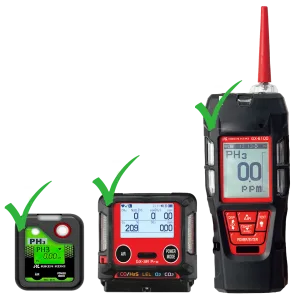
Phosphine Gas Detection Instruments
A safety framework is only as good as the equipment that supports it. You can write the best procedure in the world, but if your team doesn’t have a detector that’s reliable, easy to use, and rated for the environment they’re working in, the risk remains.
That’s the gap Control Equipment fills – our phosphine monitoring solutions include:
- 04 SERIES Single Gas Monitor — A compact, lightweight personal monitor worn within the worker’s breathing zone, providing continuous monitoring of phosphine exposure throughout the workday.
- GX-3R PRO Multi-gas Monitor — An ultra-lightweight personal monitor ideal for confined space entry and routine fumigation activities where reliable phosphine monitoring is essential.
- GX-6100 Portable Gas Monitor — A versatile handheld instrument well-suited for fumigation clearance testing, site verification, and workplace safety assessments.
Whether you need a single-gas monitor for one worker, a multi-gas unit for confined-space work, or a handheld instrument for clearance testing and site verification, Control Equipment has a solution tailored to your team’s way of working.
Talk to Australia’s Gas Detection Experts
Control Equipment has been helping Australian businesses manage airborne hazards like phosphine gas for years. Whether you need a single personal detector for a fumigator, a fleet of units for a grain-handling site, or a broader gas-detection strategy across an industrial facility, our team can help you find the right fit.
Get in touch with our sales team today to discuss your site’s phosphine risks, or visit Fumigation Gas Monitoring Instruments for more information about our phosphine gas monitoring solutions.
Find out more about Phosphine Gas Detection Solutions?
 Make an Enquiry Today!