
Benzene Monitoring | Protecting Workers in Hazardous Environments
Benzene (C6H6) is a significant concern in many industries, particularly in the oil, gas, and petrochemical sectors, due to its hazardous properties. This blog post explains what benzene is, where it can be found, its health effects, and how advanced technology, like the GX-6100 multi-gas monitor, provides an essential solution for effective monitoring.
What is Benzene and Where is it Found?
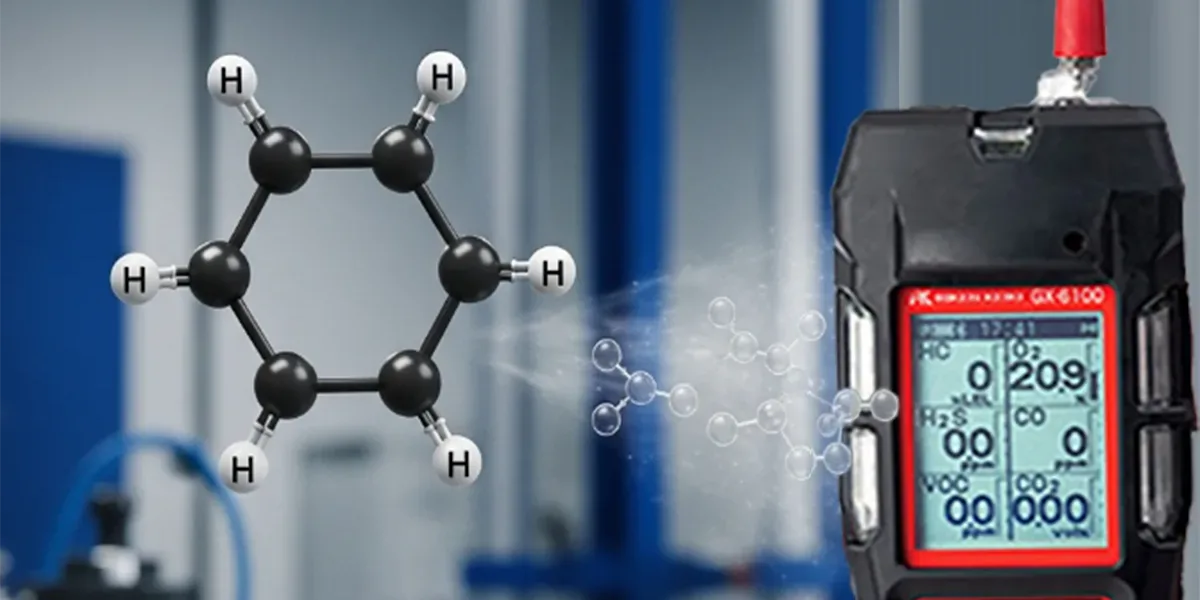
Benzene (C6H6) is a volatile, colourless, and highly flammable aromatic hydrocarbon. As a Volatile Organic Compound (VOC), its unique molecular structure—a ring of six carbon atoms with alternating double bonds—makes it both chemically stable and easy to evaporate into the atmosphere.
You’ll find benzene as a naturally occurring component in crude oil and petroleum-based products. It’s widely present across the entire oil and gas value chain, including:
- Upstream operations: Think drilling platforms and wellheads.
- Midstream processes Includes pipelines, storage tanks, and compressor stations.
- Downstream facilities: Refineries and chemical plants are prime examples.
Apart from industrial processes, benzene can also be emitted from incomplete burning of fossil fuels, tobacco smoke, and other human activities. Its ability to move through air, water, and soil creates significant worries about airborne exposure, groundwater pollution, and soil contamination, especially near production and processing facilities.
Health and Safety Implications
The dangers of benzene exposure are serious. The International Agency for Research on Cancer (IARC) classifies benzene as a Group 1 human carcinogen. It is associated with acute myeloid leukemia (AML) and other blood disorders because it can disrupt bone marrow function, even at relatively low levels.
Due to its high volatility, inhalation is the primary route of occupational exposure, especially in enclosed or poorly ventilated spaces. This is why stringent regulatory exposure recommendations are in place:
- OSHA Permissible Exposure Limit (PEL): 1 part per million (ppm) as an 8-hour time-weighted average (TWA)
- NIOSH Recommended Exposure Limit (REL): 0.1 ppm TWA over 8 hours
- NIOSH Immediately Dangerous to Life or Health (IDLH) level: 500 ppm
- ACGIH TLV: 0.02 ppm TWA over 8 hours
Given the hazardous nature of benzene, NIOSH advises using supplied-air respirators or self-contained breathing apparatus (SCBA) when concentrations exceed the REL. Additionally, continuous gas monitoring is crucial for safeguarding workers during any operations involving potential benzene release.
Control Equipment’s Solution for Benzene Detection: The GX-6100 with PID Technology
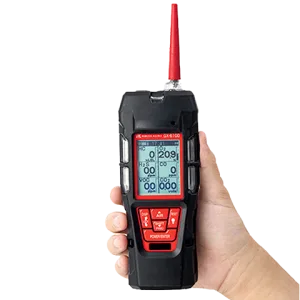
Control Equipment provides an accurate, efficient solution for benzene detection with its GX-6100 multi-gas monitor. This advanced device features a 10.0 eV Photoionisation Detector (PID) and a dedicated benzene filtration tube.
Benzene-Specific Detection Using 10.0 eV PID + Filtration Tube
The GX-6100 utilises benzene’s low ionisation potential, enabling efficient ionisation by a 10.0 eV PID lamp. Importantly, many other interfering compounds with higher ionisation energies are kept out. When paired with the GX6100 benzene-specific filter tube, this system eliminates common VOC interferences, ensuring the PID measures only benzene for highly accurate readings.
Benzene Measuring Mode Uses Temperature to Determine Sampling Time
While the GX-6100’s 10.0 PID lamp can operate in a standard VOC monitoring mode, detecting up to 300 different VOCs (including benzene), its Benzene-Specific Mode is genuinely innovative. In this mode, the GX-6100 automatically determines the appropriate sampling time for measuring benzene through the filter tube based on the current temperature. This sampling time can range from 35 to 135 seconds, enhancing accuracy.
Dual PID Function
The GX-6100 is unique in that it is the only gas monitor capable of running two PID lamps simultaneously within a single device. By adding a second PID lamp alongside the benzene-specific 10.0 PID lamp, this single unit can perform the work of two gas monitors. It offers monitoring across a wide range of VOCs with a library of over 600 compounds, while still allowing for quick switching to Benzene Specific Mode whenever needed.
Versatile Multi-Gas Monitoring Platform
More than just a PID monitor, the GX-6000 supports up to six simultaneous gas sensors, offering comprehensive atmospheric monitoring in a single robust device. Available sensor configurations include::
- LEL / %Vol / PPM Hydrocarbons (combustible gas detection)
- Oxygen (O2)
- Hydrogen Sulphide (H2S)
- Carbon Monoxide (CO)
- Smart EC toxic sensors for: NH3, Cl2, HCN, NO2, PH3, & SO2
- Photoionisation Detectors (PID) with four optional lamps:
- 10.6 eV (broad range VOCs low range)
- 10.6 eV (broad range VOCs high range)
- 11.7 eV (high-sensitivity VOCs)
- 10.0 eV (benzene-selective with filter tube)
Durability and User-Focused Design
Designed for the most challenging environments, the GX-6100 boasts:
- IP-67-rated water and dust resistance
- Durable enclosure designed to withstand drops and vibrations
- A large, colour LCD display with easy-to-read gas concentration readings
- Intuitive menu navigation and one-button operation for essential functions
- A rechargeable battery with a long runtime for extended field use
Conclusion
For industries facing growing demands for benzene monitoring, the GX-6100, equipped with a 10.0 eV PID and a benzene filter tube, provides a highly advanced yet truly field-ready solution. This system provides accurate benzene measurements, supports comprehensive multi-gas analysis, and is built to endure the challenges of real-world use. It is an essential tool for protecting worker safety and ensuring environmental compliance.
Article references: RKI Instruments | https://pergam-suisse.ch/tpost/t53ju5ami0-uav-methane-detection-latest-advances-an
Want to learn more about how the GX-6100 can enhance safety in your operations?
 Make an Enquiry Today!