
Dust in the workplace continues to receive international attention as a hidden killer. The recent outbreak of respirable crystalline silica dust has sparked a health crisis. Silicosis is a form of occupational lung disease caused by inhalation of crystalline silica dust, which resulted in 46,000 deaths globally in 2013, but exposure to silica dust is preventable. In this article, we will look at some of the broader ramifications of exposure to dust at work and the role of personal dust sampling pumps in safeguarding staff.
Health matters
There are a wide range of substances in the workplace that has the potential to cause harm to health if ingested, inhaled, or come in contact with skin. These can lead to irreversible respiratory diseases, asthma or eczema, amongst a long list of potential health problems.
Under the Guidance on the Interpretation of Workplace Exposure Standards for Airborne Contaminants inhalable dust should be measured according to AS 3640-2009: Workplace atmospheres Method for sampling and gravimetric determination of inhalable dust7. The inhalable mass fractions of inhalable dust are defined in ISO 770829 and have been adopted by AS 3640 and summarised in the table below.
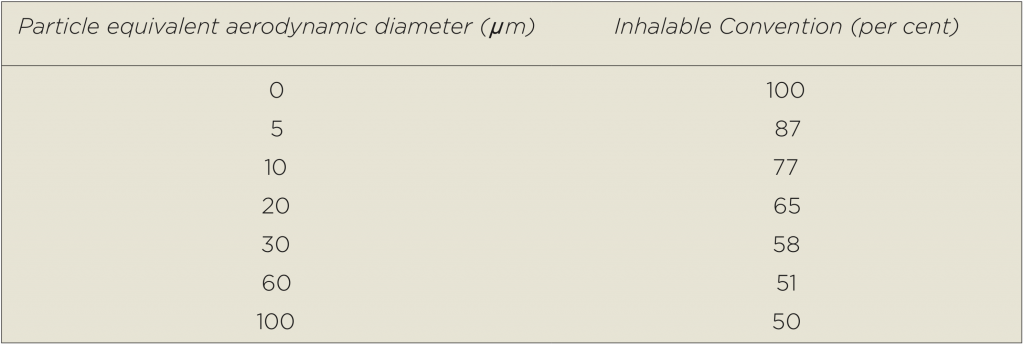
The inhalable fraction of dust entering the respiratory tract may be further divided into ‘respirable’ and ‘non-respirable’ fractions. The respirable fraction is composed of the very fine dust which is able to reach the lower bronchioles and alveolar regions of the lung. Respirable dust is measured by a size-selective device according to AS 2985-2009: Workplace atmospheres – Method for sampling and gravimetric determination of respirable dust6. This Australian Standard also defines respirable dust and adopted the ISO 770829 definition of. respirable dust, which is the percentage of inhalable matter collected by a device conforming to a sample efficiency curve which passes through the points in the table below.

From the thousands of substances that can be found within a working environment, 500 are given specific limits, under Workplace Exposure Limits regulations, commonly referred to as WELs. For example, cobalt metal has an exposure limit of 0.1 mg/m3, and silica is 0.1 mg/m3, meaning workers can only be exposed to a small amount before the substance potentially becomes hazardous to health. If such substances are identified in the working environment, employers must be familiar with the relevant exposure limit figures.
Accurate measurement
Personal monitoring in the form of personal dust sampling pumps is the preferred method of measuring dust exposure levels in the workplace, allowing employers to remain compliant with government standards of safety by providing an accurate record of individual exposure levels.
Personal pumps are efficient, practical and adaptable, offering tailored features depending on individual requirements. The pumps provide information on temperatures and dust levels, alerting employers about harmful levels of dust in the atmosphere and potential explosion risk. To ensure personal sampling pumps accurately measure inhalable dust levels, filters connected to the devices are worn near the breathing zone (mouth and nose) absorbing air and catching particles, mimicking the way a human breathes. When required, the particles collected are sent to a laboratory for further testing.
In some instances, this is replacing traditional methods whereby reports taken from an external occupational hygienist inspecting the workplace provided evidence of dust levels.
Personal pumps offer an enhanced monitoring system able to provide continuous data records. Data can be collected throughout seasonal and weather changes – in the summer months; there may be better ventilation, where windows might be open, as opposed to winter months where lower ventilation can make for a dustier environment. Based on the findings, dust control measures can be modified. Workers may be required to wear additional respiratory protective equipment, or the location may need to be fitted with ventilation systems.
When new processes are introduced, such as new machinery and ventilation equipment, the personal pumps enable tests to be made to ensure exposure limits are kept to a minimum. Ultimately, this allows workforces to become more engaged, providing staff with detailed information on how their health is being safeguarded in the workplace.
Asbestos monitoring
The World Health Organisation estimates that 107,000 workers globally die every year from exposure to asbestos, with many succumbing to fatal respiratory diseases such as mesothelioma.
Asbestos has not been used in domestic building materials since the 1980s, but it was not until 31 December 2003 that asbestos and all products containing asbestos were banned throughout Australia. Asbestos has been used in 70% of countries around the world.
For the many workers involved in asbestos removal, personal sampling pumps are increasingly being used to measure individual exposure alongside room monitors, giving a more accurate indication of specific risks workers are exposed to. Tests are required to ensure the air quality of the contaminated area is safe for individuals to remove the substance and to measure airborne exposures.
With personal sampling pumps, workforces can continue with the removal of asbestos, knowing that their overall exposure is being carefully monitored. For this specific task, the pumps must be worn on the body as part of their protective clothing, which is then sprayed down after working in the contaminated area.
When dealing with asbestos, a filter with grids is used which allows for the asbestos fibres to be counted by microscope in a laboratory. The sample is analysed after the shift has ended, ensuring personal exposure is below the level allowed, providing an essential historical record.
The latest personal sampling pumps are both small and light, with Bluetooth connectivity giving the ability to access data collected remotely. They should also have a smooth surface for easy cleaning.
Those being used in environments where there is a risk of explosions, such as the petrochemical, pharmaceutical or mining industries, will also need to be intrinsically safe and certified to IECEx or other explosion protection standards, depending on where they are being used.
How we can help
Control Equipment Pty Ltd supply suitable personal air sampling equipment to ensure maximum safety for all employees exposed to potential airborne risks. For more information, contact us to talk with a trained professional who will assist you to provide a suitable solution to manage this risk.
