
Beyond Dust | Measuring the Invisible in Diesel Exhaust
Diesel Particulate Matter and Ultrafine Particle Monitoring: Why Measuring What You Can’t See Matters
This blog explains the significance of diesel particulate matter and ultrafine particles, the technologies used to monitor diesel emissions and why real-time diesel particulate matter monitoring is becoming increasingly important.
Diesel engines remain essential across many of Australia’s most important industries. From underground mining and tunnelling to construction, transport, agriculture, oil and gas, ports and vehicle maintenance, diesel-powered equipment provides the power needed to keep operations moving. But diesel exhaust comes with a significant occupational hygiene challenge.
For decades, occupational hygienists have monitored diesel particulate matter (DPM) using established sampling and analytical techniques. These methods remain important, particularly where compliance with a workplace exposure limit is required.
Why Diesel Engine Fumes Pose a Significant Hazard
Safe Work Australia’s current guidance specifically identifies miners, construction workers, oil and gas workers, forklift drivers, loading dock workers, truck drivers, farmworkers, stevedores and vehicle maintenance workers as those who may be exposed to Diesel Engine Emissions (DEE).
Inhalation is the primary route of exposure to diesel exhaust emissions at work, and it can cause immediate effects such as irritation of the eyes, nose, throat, and lungs; dizziness; nausea; coughing; or severe asphyxiation from carbon monoxide.
Long-term exposure is linked to increased risks of lung and bladder cancers, as DEE and its contaminant PAHs are carcinogenic. Each year, about 130 Australians develop lung cancer due to occupational DEE exposure. Chronic exposure can also worsen asthma and allergies and increase the risk of heart and lung diseases, including chronic obstructive pulmonary disease.
Common sources include heavy vehicles such as trucks, buses, trains, tractors, ships, loaders, forklifts, and bulldozers, as well as other construction and mining equipment. DEE can also originate from stationary power sources such as generators and winch motors.
What is Diesel Particulate Matter?
The main components of diesel engine emissions are gases like nitrogen, oxygen, carbon dioxide, and water vapour. A small portion includes hazardous chemicals such as carbon monoxide, nitrous oxide, nitrogen dioxide, sulphur oxides, and diesel particulate matter (DPM). DEE may also contain trace amounts of hydrocarbons like formaldehyde, benzene, toluene, phenol, PAHs, and others.
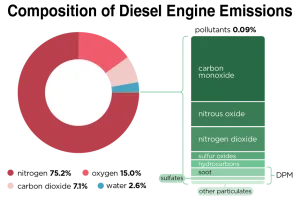 Diesel Particulate Matter (DPM) is the particulate component of diesel engine exhaust and is a small fraction of total diesel exhaust emissions. Consisting mainly of soot, unburned hydrocarbons, water, sulphates, and trace contaminants from oil or fuel additives, some of which are hazardous, it can include metals such as arsenic, cadmium, and chromium. Over 90% of DPM are smaller than 1 micrometre (μm).
Research into diesel emissions in underground mining has shown that DPM predominantly occupies the fine and ultrafine particle size ranges, with particle characteristics influenced by engine technology, operating conditions, fuel, maintenance and exhaust after-treatment systems.
This creates an important distinction between diesel exhaust and ordinary airborne dust.
Ultrafine Particle Monitoring might be a Small Matter, but its a Big Deal
A conventional dust monitor may be excellent at measuring particles in the respirable, PM2.5 or PM10 size ranges, but diesel exhaust contains a substantial population of particles much smaller than these conventional dust fractions. These are known as Ultrafine Particles (UFPs).
Most DPM consists of ultrafine particles smaller than 100 nanometres. At this scale, particle behaviour is markedly different from that of the larger dust particles encountered in many conventional occupational hygiene applications and not accurately measured by standard dust monitors targeting larger particles.
Ultrafine particles have extremely small individual masses, but they can occur in very large numbers. Their small size also means that they can penetrate deeply into the respiratory system. These tiny particles adsorb hazardous gases and other hazardous chemical components from the DEE and can remain airborne for long periods, penetrating deep into the lungs. This is why measuring only particle mass does not necessarily tell the whole story
Although the mass of particles may be similar across environments, the number and surface area of ultrafine particles can vary greatly, making measurements such as particle number concentration and Lung-Deposited Surface Area (LDSA) increasingly important for assessing diesel emissions.
Diesel Particulate Matter Monitoring is Evolving
The industry has moved from relying primarily on laboratory analysis of integrated samples to increasingly sophisticated real-time technologies capable of measuring particle mass, particle number, size distribution and particle surface area.
Traditional methods have monitored diesel particulate matter (DPM) for decades, especially for compliance. However, technological advancements now enable real-time monitoring that provides detailed insights into ultrafine particle levels, source identification, emission changes, and deposit risks. This shift allows organisations not only to measure exposure but to understand and manage its causes more effectively, improving safety interventions.
Today, monitoring can go beyond simply asking “How much diesel particulate matter is present?” to investigate questions such as:
- How many ultrafine particles are present?
- How small are those particles?
- How rapidly do concentrations change?
- Where is diesel exhaust coming from?
- Is ventilation effectively controlling emissions?
- Is an exhaust filtration system working?
- What happens when diesel equipment enters or leaves a work area?
- How much particulate matter is likely to deposit in the lungs?
This is where real-time monitoring of diesel particulate and ultrafine particles becomes increasingly valuable.
Monitoring Isn’t Just About Compliance
One of the most important advantages of real-time DPM and ultrafine particle monitoring is that it can help organisations understand why exposure occurs.
Modern engines, cleaner fuels, diesel particulate filters, improved exhaust after-treatment, better maintenance and alternative power technologies have all contributed to reductions in diesel emissions. But improved controls create a new monitoring challenge.
As emissions decrease, the ability to detect small changes becomes more important. A poorly performing diesel particulate filter, a deteriorating engine, inadequate ventilation or an isolated emission source may not necessarily produce an obvious increase in conventional dust measurements.
A traditional shift-based sample might tell you: “The worker’s exposure was X.” Real-time monitoring can potentially tell you:
- “The concentration increased when this vehicle entered the area.”
- “Particle levels fell rapidly when ventilation increased.”
- “This piece of equipment is producing a significantly different particle signature.”
- “Particle concentrations increase during engine warm-up.”
- “A change in filtration or maintenance has altered emissions.”
That information can be invaluable when implementing the hierarchy of controls and help organisations move from simply measuring exposure to understanding and controlling its source.
New Workplace Rules for Diesel Emissions
Safe Work Australia has issued new guidance on managing diesel emissions, establishing a limit of 0.01 mg/m³ for workplace exposure limit diesel particulate matter effective from 1 December 2026. This change, part of Australia’s shift from Workplace Exposure Standards to mandatory Workplace Exposure Limits, replaces flexible guidelines with enforceable caps to protect workers from diesel exhaust, a known Group 1 carcinogen. DPM is measured as Respirable Elemental Carbon (REC), the method specified in the new Workplace Exposure Limit.
| Contaminant | Current WES TWA | New WEL TWA (From Dec 2026) | Regulatory Change / Impact |
| Diesel Particulate Matter (DPM) (Measured as Respirable Elemental Carbon) | 0.1 mg/m³ (de facto guidance) | 0.01 mg/m³ | 90% reduction. Legally mandated national limit for the first time. |
| Nitric Oxide (NO) | 25 ppm (31 mg/m³) | 2 ppm (2.5 mg/m³) | Over 90% reduction in acceptable workplace concentration. |
| Carbon Monoxide (CO) | 30 ppm (34 mg/m³) | 20 ppm (23 mg/m³) | 33% reduction, tightening baseline restrictions. |
| Sulphur Dioxide (SO₂) | 2 ppm TWA / 5 ppm STEL | 0.25 ppm STEL (0.65 mg/m³) | 95% reduction to the short-term 15-minute exposure window. |
Where is Diesel Particulate Matter Monitoring Used?
DPM monitoring is particularly important wherever diesel engines operate in environments where workers may be exposed to their emissions. Exposure levels are higher in confined spaces such as workshops, parking garages, tunnels, mines, covered roadways, and vehicle holds, where exhaust can accumulate.
 Underground mining
Underground mining is one of the most significant applications. Diesel-powered loaders, trucks, drills, personnel carriers and other mobile equipment can operate in enclosed or semi-enclosed environments. Unlike open-air environments, underground workings rely heavily on engineered ventilation to dilute and remove contaminants.
Australian research has consistently identified underground mining as a key setting for managing DPM exposure. A recent study of more than 24,000 historical DPM exposure records from Western Australian mines found that underground workers remain a significant exposure group, with underground gold mining facing particular challenges as exposure limits change.
Monitoring can therefore help occupational hygienists and mine operators understand:
- Personal worker exposure
- Diesel emission hotspots
- Ventilation performance
- Changes between work areas
- Emissions from individual vehicles or equipment
- The effectiveness of diesel particulate filters
- The impact of engine maintenance
 Tunnelling and underground construction
Tunnels present many of the same challenges as underground mines.
Diesel-powered equipment may operate in confined spaces with limited natural dispersion. Ventilation is a critical control, and real-time monitoring can help demonstrate how particulate concentrations change as equipment operates and as ventilation conditions vary.
 Construction
Construction sites can contain numerous diesel-powered machines operating simultaneously, including excavators, loaders, cranes, generators, trucks and other mobile equipment.
Monitoring can help identify situations where workers may be exposed to diesel exhaust, particularly in enclosed or poorly ventilated areas, or where multiple diesel engines operate close together.
 Transport, logistics and loading facilities
Truck depots, loading docks, distribution centres and logistics facilities can experience repeated diesel exhaust emissions from heavy vehicles entering, idling and departing.
Real-time monitoring can help identify emission patterns and assess the effectiveness of ventilation and operational controls.
 Agriculture, ports, oil and gas and other industries
Diesel-powered equipment is also widely used in agriculture, ports, marine operations, oil and gas and other industrial environments.
 Workshops and vehicle maintenance
Diesel engine workshops and maintenance facilities can be another important application.
Engines may be started, tested or operated indoors, sometimes repeatedly throughout the working day. Monitoring can help identify exhaust accumulation and assess the effectiveness of local exhaust ventilation and other controls.
XPS TITAN-DPM | A New Generation of Diesel Emission Monitoring
The XPS TITAN-DPM represents a significant step forward in real-time monitoring of diesel particulate and ultrafine particles by combining multiple particle measurement methods on a single platform.
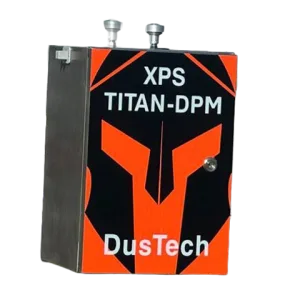 At the heart of the system is the ability to measure particles from approximately 10 nanometres to 40 micrometres. That is an exceptionally broad particle-size range for a workplace and environmental monitoring platform.
By combining technologies to detect the ultrafine particle fraction with optical particle counting for larger particles, the XPS TITAN-DPM can identify a wide range of pollutants.
- Diesel particulate matter mass concentration
- Nanoparticle/ultrafine particle number concentration
- Lung Deposited Surface Area (LDSA)
- PM1.0, PM2.5, PM4.25, PM10, TSP
- Particle size/count information
- Environmental parameters
- Optional gas measurements
The XPS TITAN-DPM measurement capability extends to particle number concentrations of up to 100 million particles/cm³, while DPM mass measurement extends to 80,000 µg/m³ and LDSA to 100,000 µm²/cm³.
Why Measuring Down to 10 Nanometres Matters
Arguably the most significant feature of the XPS TITAN-DPM
Diesel exhaust contains particles across a wide size distribution, including ultrafine particles. An instrument that measures only down to about 100 nm may miss a significant portion of the smallest particles. By extending the measurement down to 10 nm, the XPS TITAN-DPM is designed to capture a much larger share of the diesel particle-size distribution, including the ultrafine fraction. This enables monitoring of three complementary characteristics of diesel particulate:
- How much particulate matter is present? Mass concentration is familiar to occupational hygienists and remains an important metric for exposure assessment and regulatory purposes.
- How many particles are present? Ultrafine particles can contribute relatively little to total mass while contributing enormously to particle number. Therefore, particle number provides information that mass concentration alone cannot convey.
- How much particle surface area is likely to deposit in the lungs? LDSA provides another way to characterise exposure to ultrafine particles by estimating the surface area of particles deposited in the respiratory system.
Together, these measurements provide a much more complete picture of the aerosol than any single measurement can. For industries such as mining, tunnelling, construction, transport and heavy vehicle maintenance, this provides an opportunity to investigate diesel emissions in considerably more detail.
Particle number. Particle size. Surface area. Mass. Real-time behaviour.
The ability to see all of these characteristics provides occupational hygienists, engineers and site managers with better
information to investigate emission sources, assess controls and understand workplace exposure.
The XPS TITAN-DPM brings these capabilities together on a single platform — offering a new approach to real-time monitoring of diesel particulate and ultrafine particles.
Find out more about the XPS TITAN-DPM or visit our Occupational Hygiene Dust & Environmental Monitors page to view other products in our range.
Article References:
Safe Work Australia’s Workplace Exposure Limits for Airborne Contaminants contains a list of mandatory exposure limits under the WHS Regulations.
Safe Work Australia: Managing the risks of exposure to diesel engine emissions in the workplace Guide June 2026
Need to Monitor Engine Diesel Emissions?
 Make an Enquiry Today!