
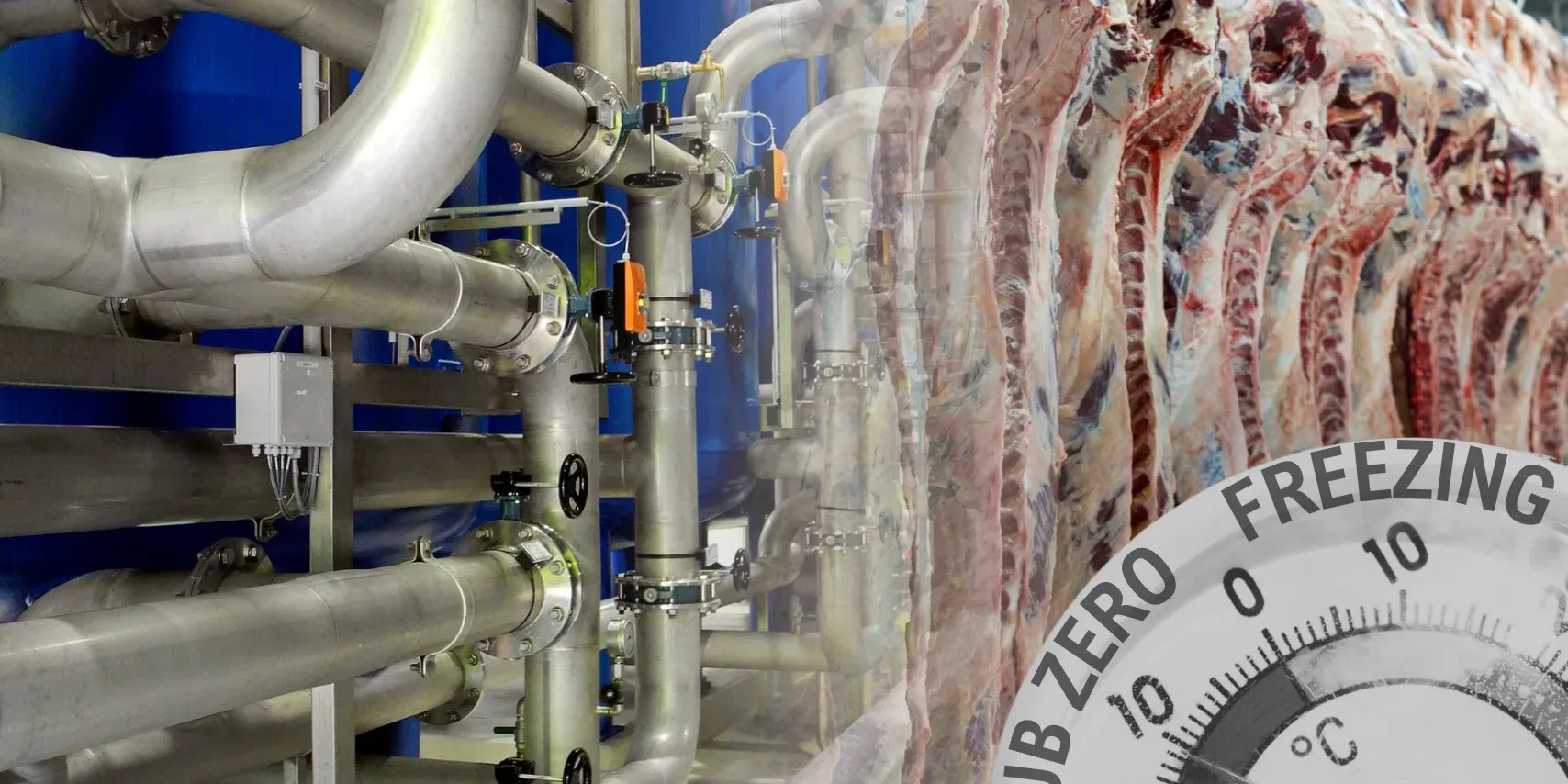
When Ammonia Goes Wrong
What Australian Abattoir Incidents Teach Us about Gas Detection
Anhydrous ammonia (NH3) is the refrigerant of choice for most Australian abattoirs and meat processing facilities — efficient, cost-effective, and free of the ozone-depleting and global-warming baggage that comes with synthetic alternatives. It’s also toxic, corrosive, and flammable at high concentrations. When something goes wrong with an ammonia system, it tends to go wrong fast, and the consequences are measured in hospitalisations, evacuations, and regulatory action — not near-misses. Ammonia gas detection in abattoirs is non-negotiable.
Looking at how these incidents occur across Australian sites reveals a pattern. It’s rarely one catastrophic, unforeseeable event. It’s usually a small, preventable failure that a facility’s detection and response systems should have caught long before it became a crisis.
How Ammonia Incidents Occur in Meat Processing Facilities
Mechanical failure and maintenance neglect. Flanges, gaskets, and valve seals degrade over time. One major NSW incident traced back to something as simple as a missing nut and bolt and a degraded gasket on a discharge pipe — pressurised liquid ammonia escaped, workers were hospitalised, and the operator faced regulatory fines. Slow leaks from worn valve seals in enclosed compressor rooms are just as dangerous, precisely because they’re gradual enough to go unnoticed until concentrations build.
Physical impact and accidental damage. Processing environments are busy, and equipment gets struck. A bone-in product puncturing a plate freezer coil has triggered mass evacuations at the site and the deployment of HazMat. Forklifts and machinery operating near exposed refrigeration pipework carry the same risk — one impact, one high-volume release.
Mass exposure and toxic inhalation. Ammonia is corrosive to human tissue — inhalation damages the eyes, nose, throat, and lower respiratory tract, while liquid contact causes chemical and cryogenic burns. The most dangerous secondary risk is the rescue attempt: when a worker is incapacitated in an enclosed space at concentrations above the 300 ppm IDLH threshold, colleagues without breathing apparatus who go in after them can become the next casualties.
Facility-wide evacuation and off-site plume travel. A liquid line breach at a large plant can force hundreds of night-shift workers to evacuate and shut down operations entirely. Wind-driven vapour clouds can travel off-site, forcing fire services to establish exclusion zones and issue shelter-in-place orders for neighbouring workplaces and residents.
The Root Cause Regulators Keep Flagging
WorkSafe Victoria, SafeWork NSW, and Workplace Health and Safety Queensland have all pointed to the same systemic gaps, incident after incident:
- Alarm thresholds set too high. Fixed gas detectors calibrated above safe limits — sometimes above the 300 ppm IDLH mark itself — delay the early warning that should trigger evacuation, not confirm it’s already too late.
- Contractor blind spots. Outsourcing refrigeration maintenance to third parties doesn’t transfer the legal duty to maintain plant integrity. Facility operators remain accountable.
- No independent ventilation trigger. Emergency mechanical ventilation that depends on manual activation, rather than triggering automatically off gas detection, fails exactly when it’s needed most.
In other words, the equipment that’s supposed to catch a leak early is often the weak link — set too conservatively, poorly maintained, or disconnected from the response systems it should be driving.
The 2026 Deadline That Changes the Calculation | The 2026 Workplace Exposure Limit (WEL) Changes for Ammonia
There’s a regulatory shift making this more urgent than a general safety refresh. Ammonia’s workplace exposure limit is tightening: the current Workplace Exposure Standard (WES) of 25 ppm (8-hour TWA) / 35 ppm (15-minute STEL) is being replaced nationally by the new Workplace Exposure Limit (WEL) of 20 ppm TWA / 35 ppm STEL, effective 1 December 2026. The STEL is unchanged, but the TWA — the figure that governs continuous background monitoring — drops by 20%.
For any abattoir running fixed detection calibrated against the old 25 ppm threshold, that’s not a paperwork update. It’s a compliance gap: a facility can be operating within its current alarm settings and still be over the new limit the moment the new limit takes effect. Reviewing sensor calibration and alarm setpoints against the 20 ppm WEL before December 2026 is now a concrete action item, not a “nice to have.”
Why Detection Thresholds are the Real Problem to Solve
The pattern across these incidents isn’t a lack of awareness of ammonia’s dangers — every abattoir operator knows that. It’s a gap between the theoretical safety case and what’s actually installed on the plant room wall. A sensor calibrated too high, sited in the wrong location, or not wired into automatic ventilation and alarm response gives a false sense of coverage. It’s compliance on paper, not protection in practice.
This is exactly the gap Control Equipment’s CTI GG-NH3 Ammonia Gas Detector is built to close.
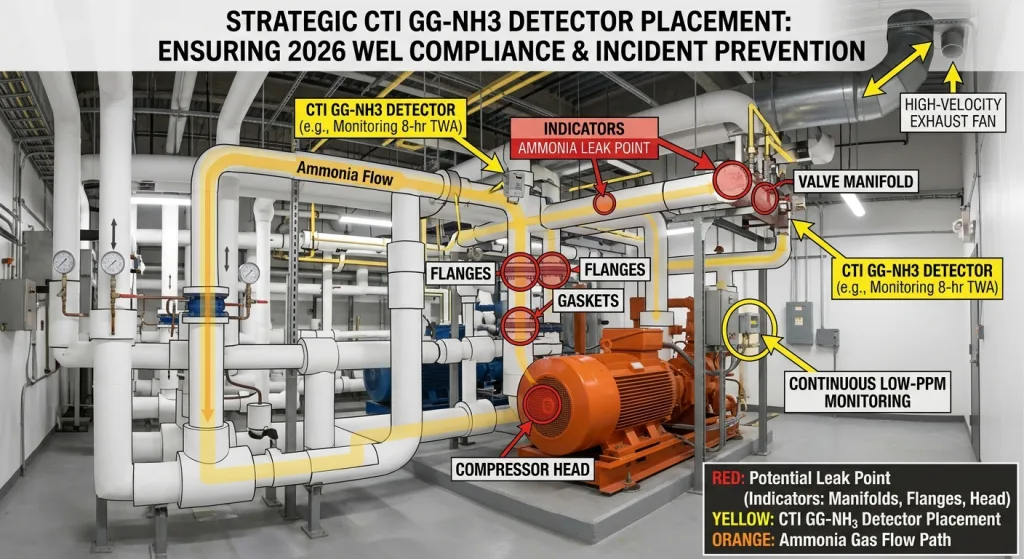
CTI GG-NH3 Ammonia Gas Detector Specification & Placement
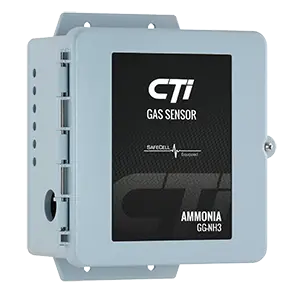
The GG-NH3 uses ammonia-specific electrochemical sensor technology, accurate down to 5 ppm — well below the incoming 20 ppm WEL — with no false alarms. A few specifics that matter directly for abattoir conditions:
- Built for washdown environments. The sensor housing is NEMA 3RX-rated, injection-moulded polycarbonate (with an optional 316-grade stainless steel enclosure), specifically designed for washdown duty — the exact conditions in compressor rooms and processing areas that are hosed down daily.
- Fast response. T50 (50% response) in under 30 seconds, T90 in under 60 seconds — the difference between an alarm firing early enough to act and one that confirms a leak after it’s already spread.
- Stable output through temperature swings. The 4-20 mA linear output isn’t affected by temperature shifts during washdowns or defrost cycles, and an internal temperature-controlled enclosure extends cell life in harsh conditions (rated -46°C to +50°C).
- Self-monitoring. SAFECELL technology continuously checks the electrochemical cell’s electrical viability and drops the signal if the cell fails or is removed — so a dead sensor doesn’t sit there silently reading “all clear.”
- Calibrated to the standards abattoirs need to meet. Field-calibratable across 0–100, 0–250, 0–500, and 0–1000 ppm ranges, built to accurately monitor PEL, STEL, and IDLH setpoints — the same framework the incoming WEL operates under.
- Built to last. 2-year warranty including the sensor element, backed by SGS listing to UL 61010-1 and CSA C22.2 No. 61010-1-12.
Placement matters as much as the sensor itself. Ceiling-mounted units detect a rising leak near flanges and gaskets early enough to trigger ventilation before a TWA exposure limit is exceeded. Units positioned near valve manifolds and the compressor head — the areas regulators repeatedly flag as failure points — cover the faster-developing STEL scenario. Continuous low-level monitoring in breathing-zone areas closes the gap that would otherwise turn a contained leak into a mass-evacuation event.
The Takeaway
The abattoirs that end up in a regulator’s incident report rarely lacked equipment — they lacked equipment that was correctly specified, positioned, and integrated into a response plan.
Getting ammonia detection right isn’t about ticking a compliance box; it’s about ensuring the first sign of a leak is a low-level alarm and the ventilation system kicking in, not a shift-wide evacuation.
With the WEL taking effect on 1 December 2026, now is the time to review your facility’s ammonia detection setup — thresholds, sensor placement, or how detection ties into your ventilation and emergency response.
Talk to Australia’s Gas Detection Experts
Get in touch with our sales team today to discuss your site’s ammonia risks, or visit the CTI Ammonia Sensor product page for more information.
Find out more about Ammonia Gas Detection Solutions?
 Make an Enquiry Today!